



By Philip Basa
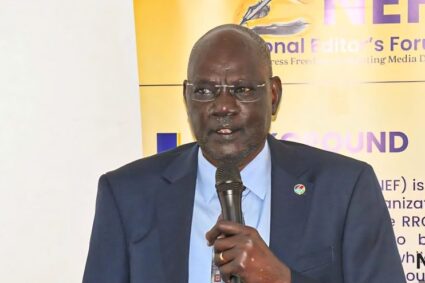
Central Equatoria State Minister of Land and Housing, David Morbe, has denied allegations of grabbing the land in St Stephen’s Parish in Munuki.
This came after the Church accused the minister of grabbing the Church land under the pretext of road demarcation to provide social services to the neighboring residents.
In response, Minister Morbe said the State government decided to demolish some parts of Munuki Hai Jerzera last month following the demand by the residents.
“What happened last month was not a surprise. I sent the delegation headed by the director general of the Ministry of Land and Housing to Munuki Hai Jerzera,” he explained.
He said the committee came and met with residents, and they agreed on the opening of the road within the area.
“I came to learn that the church accused me of acting on the order of Governor Augustino Jadalla Wani.”
“The responsibility of the state government is to bring services closer to people; for that matter, all the community, including the Hai Jerzera, will not be left out as we work for all, not just individuals,” Morbe asserted.
The minister vowed to continue with the exercise of opening the roads.
He said those who have the land documents will be given the land, including the Church.
“St Stephen’s parish will be given eight plots for the church to continue worshiping the Lord. We urge all churches to work hand in hand with the government, such that the development of South Sudan should go ahead.”
Morbe said the government does not have a problem with any church, and they recognize the contributions of the church.
Early this week, Rev. Paul Samuel Paul of St Stephen’s Episcopal Church in Munuki blamed Central Equatoria Government for unlawfully demarcating its land, and urged the authorities to stop.
The Reverend said the church was established in 1965 and in 1987, it was registered by the Regional Ministry of Housing and Utilities. The church, he said, has a land lease on plot no 1567 Block B, covering an area of 9520 square meters.
This land was registered in the judiciary in March 1987, he added.
“We have taken this issue of the land to the high court in Juba, and the court ruling was in favour of the church four times. Therefore, we should respect the law because no one is above the law. As a church, we are following the right procedure of acquiring the land for the church.”