


The Minister for Finance and Planning, Agak Achuil Lual, on Thursday, blew the whistle about an impersonator using his identity on Facebook to swindle oblivious members of the public.
Agak cautioned the public not to receive or offer assistance to anyone who asks for help on social media in his name.
“It is important for the public to know that someone created a Facebook Messenger account in my name. If you receive messages offering or soliciting financial assistance, they are false,” Agak said in his Facebook post.
“When accessing all messages, the public is asked to exercise extreme caution and care in determining which ones are authentic and which ones are not,” he added.
Several South Sudanese have been victims of such forms of impersonation, including the speaker of R-TNLA, Jemma Nunu Kumba.
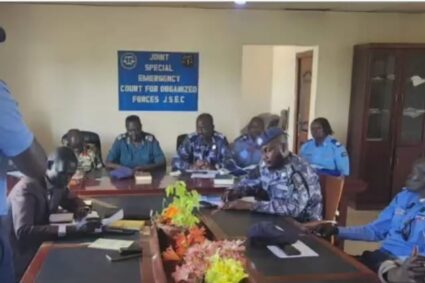
The deputy spokesperson for the police, James Dak Karlo, told the City Review yesterday that the case involving the minister of finance was not reported to them. He revealed that many such cases had been happening.
He advised that cases of cybercrime should be reported to the police because they have a team that can investigate and find out who was involved and where.
“We have not received any reports about this [but] we had been receiving such cases last year. It would have been reported to us because we have a team that can investigate it to find out what happened, when, where and who was involved. The five “Ws” and “H” have to be involved in this, ” he said.
Scam messages
On October 2, 2021, the Speaker of the Reconstituted Transitional National Legislative Assembly (R-TNLA), Jemma Nunu Kumba, warned the public against being duped by scammers.
“Be careful, I don’t chat, and my page is verified. Don’t be scammed, ” she said on her Facebook page.
Pretending to be the speaker, the scammer requested support, claiming to be in Yambio attending his or her brother’s burial and thus wanted help to ship a car from Uganda to Juba.
“[I] am (here) in Yambio now, but I will be coming back to Juba on Friday because I lost my brother, and I am (here) for (burial). Since you are there in JUBA now I would like you to help me and do for me some small urgent favours, and it’s confidential OK,” the scam’s message read.
“Sorry for the late response. OK (I have) been too busy (here) my brother. You know, before I came here, I had ordered a new car from Japan, and now it has reached Malaba, Uganda, and I would like you to help me and call my car agent there and find out if the car has been cleared and is ready to be transported to Juba since [I] am to use [it] when am in Juba and here am not able to call him OK [sic],” the message concluded.
Damala Thuch Kueth, who commented on the post, accused the citizens of the neighbouring countries of pioneering such practices.
“Those of our neighbours are serious about scamming us by using the names of our prominent politicians on social media, begging other South Sudanese for help [sic]. How comes a leader like Jemma Nunu Kumba need help from other people on social media. They thought we didn’t open our eyes,” Kueth said.
Appeal to government
Mabior Agau Nyok, during the Radio Miraya breakfast show, urged the government to investigate and punish the scammers for putting the lives of South Sudanese at risk. He said that increased arrests could help scare the culprits and reduce the practice.
“I encourage our government to be serious about these scammers because many people are victims. The government should set up a response team when something happens and somebody reports it. They should try to investigate who is behind such crimes, ” he advised.
Mabior said if the government tries to increase arrests of the scammers, they will be afraid because they will be punished.
He stressed that those who have fallen victims to cybercrimes are South Sudanese internet users, who occasionally lose money to scammers.
“The reason why people have been swindled and fallen victims is that they lack knowledge and are not aware of the cybersecurity that exposes them to attack,” Mabior said.
“In South Sudan, the situation is worse, but the good people around the world did take an interest in this country, and the reason why the situation is worse is that it lacks qualified people to deal with such a crime.”
Mabior said scammers use “phishing” cybersecurity attacks by sending a link to a person or “social engineering” in which the scammer sends a file. When you click on these, the scammer achieves his or her target.
”In some government agencies, there are no qualified people who can deal with crime. “Cyber is very critical; every company should have at least one professional, and you find that in the case of South Sudan, nobody is mitigating all the risks,” Mabior stated.
[Additional reportage by Kidega Livingstone]