


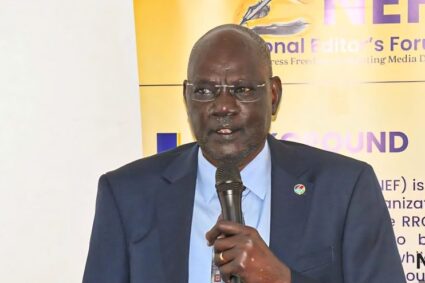



Central Bank pushes for digital economy to enhance convenience

BoSS governor, Dr. James Alic outlines benefits of a digital finance revolution, pinpointing areas country could benefit from with full inclusion, including in cross-border trade
By Emmanuel Mandella
In a bold move to modernize South Sudan’s financial sector, the Governor of the Central Bank, Dr. James Alic Garang, re-emphasized his push towards digitalizing the country’s financial services. The governor outlined the numerous benefits of a digital economy, emphasizing how it could transform both individual financial transactions and the broader macroeconomy.
In an interview with state broadcast SSBC, Dr. Garang highlighted the advantages of transitioning from cash-based transactions to digital payments, citing the speed, convenience, and improved record-keeping that come with digital platforms.
“The benefits of a digital economy is why we need to digitalize the financial services; it reduces the risks associated with current cash. For record-keeping purposes, there’s always an electronic trail when you send through digital means of payment. Additionally, digital payments significantly reduce transaction costs. You are just a click away, and the money is transmitted instantaneously,” said the governor.
Dr. Garang also noted that digital payments could be a game-changer for the government’s tax collection efforts. “Once you digitalize, you can easily track taxes for those who are paying,” he said. “For the broader economy, digital payments stimulate economic activity. The sky is the limit for what this can achieve.”
He further explained how digital payments could enhance regional trade, making it easier for citizens to transfer funds across borders. “You want to transfer something digital to your family in Kenya? Click away. You want to do that in Uganda? Just click away,” he said, emphasizing that digital payments are the future.
Randomly asked by The City Review about their thoughts on plans by the Central Bank to digitize financial transactions, Sarah Wani, a small business owner in Juba, lauded the move. “Digital payments will help my business grow. I often struggle with handling cash, and the speed of transactions will save time.”
However, others are cautious. James Maridi, a farmer in Yambio, pointed out concerns regarding access to reliable digital infrastructure. “The idea sounds great, but in rural areas like mine, we still face network issues. How will we fully benefit from this?”
On the other hand, an economist has flagged the progress, offering his green light to the Central Bank. John Saki, an economist based in Yambio, said that digitalizing financial services could help formalize the country’s large informal sector, promoting financial inclusion.
“Digital payments will not only make transactions easier but will also bring more people into the banking system. This will give the Central Bank a clearer view of the economy and allow for better monetary policy decisions,” said Saki.
However, some experts have cautioned that a successful transition will require substantial investments in digital infrastructure. “South Sudan must address its technological gaps. Otherwise, the benefits of a digital economy will be uneven, particularly for those in rural areas where digital services are limited,” warned financial analyst.
As South Sudan looks to the future, Dr. Garang remains confident that digitalizing the economy will lead to significant economic gains. “The digital means of payment is the future, it is the economy, and it is the direction where we need to move,” he said.
While the benefits are clear, the country must first overcome hurdles like limited internet access and a lack of widespread digital literacy. For South Sudan, the digital leap promises a new era of convenience and economic growth if the nation can build the infrastructure to support it.
“The digital means of payment is the future, it is the economy, and it is the direction where we need to move,” Governor of the Central Bank, Dr. James Alic Garang.