



Constructive engagement of regional heads of state ultimate goal- activist

While supporting move by government delegates to hold discussions with regional heads of state, Yakani cautions against attempts to modify documents to the detriment of opposition groups
By James Chatim
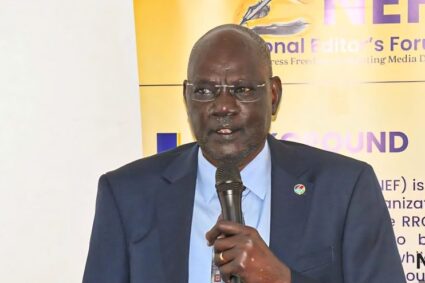
The Executive Director for the Community Empowerment for Progress Organization (CEPO), Edmund Yakani said the initiatives by government delegates to hold discussions with the regional heads of state could change the approach of the Tumaini peace Initiative.
He warned that the discussion could reshape the approach of Tumaini as the delegates are expected to make consultations with Kenyan President William Ruto and Uganda’s counterpart, Yoweri Kaguta Museveni.
In a statement to The City Review, Yakani warned that the opposition in Nairobi could reject the contents of the Tumaini document should the ongoing heads of state consultations attempt to modify the document.
Yakani stated that the probability of Tumaini failing is higher based on the outcome of those ongoing meetings.
“If the ongoing meetings are intended to reshape the content of the initial protocols of Tumaini beyond mainstreaming the institutions created, there is a likelihood that the opposition in Nairobi would not accept the outcomes.”
Those discussions that are going on between the heads of state of Kenya and Uganda may likely reshape the approach of Tumaini. In the sense that it may reshape the approach of Tumaini because those are the delegates of people who are campaigning Tumaini should be in line with R-ARCSS. So, they may go and influence William Ruto and Museveni to accept the reshaping of Tumaini to have compliance with R-ARCSS,” he said.
The activist outlined that the failure of Tumaini would result in political instability in South Sudan.
“Whatever they are doing with President William Ruto and Museveni, if it undermines the spirit of the initial protocol of Tumaini, there is a likelihood the opposition under Tumaini may reject the product. And that may mean the failure of Tumaini, we will still experience more political instability in the country,” he said, and added:
“But if the campaign is to ensure that “Tumaini is only a lift from creating new institutions, there is a high chance that Tumaini may become the last face of discussion. Because the opposition’s compromise ground in Tumaini is only when the institutions that are created under Tumaini can be reshaped to go in line with the institutions under R-ARCSS, which is also in the best interest of the government,” Yakani explained.
According to him, Tumaini peace talks are facing challenges of power sharing as some incumbent government politicians believe to remain in political seats forever.
“The challenge in the power-sharing is that we have politicians in the incumbent government who believe they own the political seats in the government. Some people feel as if they should remain ministers forever. So when they hear that we want to vacate some seats at the national government level, at a ministerial level, at the legislative level, they become more aggressive and start campaigning Tumaini.”
“But also, the reality is opposition in Tumaini cannot come and just watch the government implementing something that they are not part and parcel of the machinery of the government. So, the opposition in Nairobi needs to come and get accommodated as ministers, as MPs, and as state officials, at the same time so that they can accept Tumaini. But at the same time also the government has to compromise by vacating some seats,” Yakani added.
On Monday, October 28, Kenya’s President William Ruto engaged with South Sudan’s High-Level Standing Committee, led by Minister Martin Elia Lomuro, who delivered a message from President Salva Kiir, focusing on South Sudan’s initiative to promote the Tumaini Peace Talks within the Intergovernmental Authority on Development (IGAD) region, aimed at advancing peace efforts.
Commenting on the developments, Yakani, emphasized that while the Tumaini Initiative has the potential to contribute to peace, it must complement, not replace, the existing Revitalized Agreement on the Resolution of the Conflict in South Sudan (R-ARCSS).
He stated that linking the outcomes of the Tumaini Initiative with the unresolved tasks under the R-ARCSS offers a significant political opportunity to transition South Sudan from violence to lasting peace.
Utilities
“The challenge in the power-sharing is that we have politicians in the incumbent government who believe they own the political seats in the government. Some people feel as if they should remain ministers forever,” CEPO Executive Director, Edmund Yakani.