


Defections put Necessary Unified Forces in extinction, says Yakani

At least 53 thousand soldiers have been graduated as the first batch of the unified forces that have been in the training camp for nearly three years.
By James Chatim
The latest multiple defection of opposition troops into the national army lurks the threat to the Necessary Unification f Forces program, a civil society member has said.
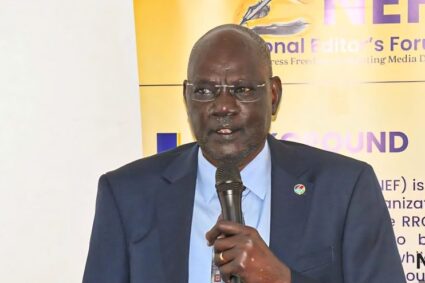
The Executive Director for the Community Empowerment for Progress Organization (CEPO), Edmund Yakani, said the Necessary Unified Forces is in extinction due to the continued defections to the SSPDF, a move that could likely undermine the efforts made in the first batch of the graduated forces.
In an exclusive interview with The City Review on Monday, Yakani said these defections are completely against the provisions of the agreement and specifically for those who were already unified, saying they have no right to again announce defections.
“These defections that are going on are completely against the provisions of the agreement because these defections that we are seeing now are undermining the spirit of the unification of the forces,” Yakani stated.
“I don’t know why they have to call it defections because defections are completely undermining Chapter 2 of the R-ARCSS. It is completely one of the prohibited actions,” Yakani explained.
He appealed to the graduated unified forces to stop defection so as not to undermine the peace agreement
“So, I feel there’s a necessity to bring this to an end. This concept of defections because unifications may be meaningless in the next few periods if we support defections like that.”
“Even if the SSPDF, which is supposed to be unified by nature, is accepting defections, then that’s terrible way,” Yakani warned.
At least 53,000 soldiers have been graduated as the first batch of the unified forces that have been in the training camp for nearly three years.
However, the agreement requires the transitional government of national unity to graduate 83,000 of Necessary Unified Forces comprising the army, police, national security, and other units to form a national army for South Sudan.
Since the conflict in Nasir County, part of the already graduated forces have been defecting to the SSPDF.
Late March, more than 200 troops formerly aligned with the Sudan People’s Liberation Army-In Opposition (SPLA-IO) have defected to the South Sudan People’s Defense Forces (SSPDF) and other organized forces of the government.
The defecting troops, led by eight commanders, were part of the integrated SPLA-IO forces trained and stationed in various military bases, including Gutmakur, Muni, Luri, Rajaf, and Rumbur.
In April alone, close to 3000 troops, allied to both SPLA-IO (600) and the South Sudan Opposition Alliance (2,000) have defected to the SSPDF.
“The forces comprise more than seven commanders and over two thousand active personnel under the command of Brigadier General Ibrahim Samir David, the Commander of SSOA Forces in the Greater Equatoria region,” said David John Kumuri, the NSS Director for Public Relations, while welcoming the defectors.
Some of the defectors have pledged their commitment to peace, renouncing their former duties and aligning their allegiance under one command.
“Across South Sudan, there are whispers of war again but I ask, what is this war for? This precious time should be dedicated to peace. I call upon all my fellow comrades to make peace a priority for the sake of our noble population,” said Brigadier General Jimmy Sikpa, who recently defected to the national army along with 500 troops, in a video footage obtained by this publication last week.
Meanwhile, peace monitors continue to pile pressure for the speedy unification and deployment of forces as stipulated in the 2018 peace agreement, even as the government says it is working to commence the second phase training of the Necessary Unification of Forces.
“Even if the SSPDF, which is supposed to be unified by nature, is accepting defections, then that’s terrible way,” Edmund Yakani, Executive Director, CEPO.