



IGAD’s new envoy tasked to ensure control over 2018 peace agreement

By Chuol Chanyong
The Executive Director of the Community Empowerment for Progress Organization (CEPO), Edmund Yakani, has urged the newly appointed Special Envoy of the Intergovernmental Authority on Development (IGAD) to be more effective and firm on monitoring South Sudan’s peace.
He said it is time for the IGAD to fully assume its responsibilities over the parties signatory to the 2018 peace agreement.
“As civil society, we would like to welcome Ambassador Moussa Djama Ali at this critical moment—a time that requires IGAD to be more effective and decisive, and to uphold its responsibilities toward the parties that signed the 2018 peace agreement, to preserve the agreement’s authenticity, legitimacy, and legality.”
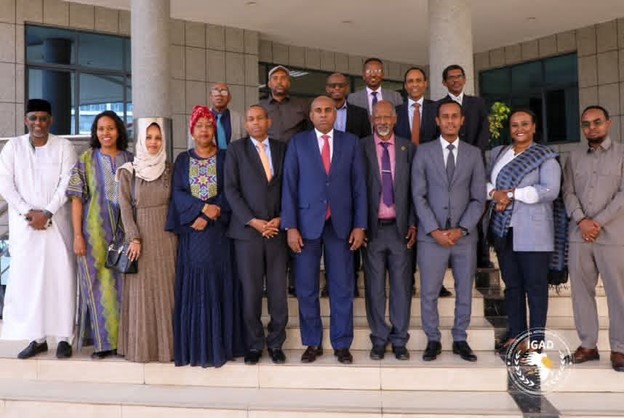
Yakani’s remarks came following the arrival of IGAD’s new Special Envoy to the Republic of South Sudan, His Excellency Ambassador Moussa Djama Ali, who replaces the former Special Envoy, Ambassador Dr. Ismail Wais, who had been out of active service for an extended period.
“We are now at a crossroads, where the fate of the peace agreement faces serious challenges due to the political stalemate that emerged after clashes between the South Sudan People’s Defence Forces (SSPDF) and the Sudan People’s Liberation Army in Opposition (SPLA-IO) in March in Nasir town, commonly referred to as the Nasir violence of March 2025. These events have severely contributed to violations of the agreement and undermined its authenticity, legitimacy, and legality.”
Yakani expressed hope that the new envoy, during his engagements with the country’s leadership, would push for the immediate monitoring of the cessation of hostilities or ceasefire, as stipulated in the 2017 Agreement on Cessation of Hostilities.
The activist also expressed hope that Ambassador Musa would promote dialogue as a means of resolving the current political deadlock, noting that the conflict parties have adopted a selective approach to dialogue.
“We hope to move toward an inclusive dialogue that brings together the legitimate parties signatory to the 2018 peace agreement. These are some of our expectations of you, Your Excellency Ambassador, upon your arrival in Juba. We hope that you will be active, present on the ground, and willing to confront the concerned parties, because the spirit of dialogue remains alive through the strong presence of the IGAD Special Envoy in South Sudan,” Yakani said.
He further voiced concern over the escalating hate speech, expressing hope that the new envoy would serve as a clear and outspoken voice against such rhetoric among South Sudanese, particularly hate speech linked to political affiliations.
He noted that some of this rhetoric is promoted by allies of the conflicting parties. He expressed hope that the issue would be addressed decisively to ensure respect for both the spirit and the letter of the peace process and its other tracks.
Ambassador Moussa Djama Ali was appointed as IGAD’s Special Envoy to South Sudan, succeeding Ambassador Ismail Wais, who held the position since June 2017. Ambassador Wais played a pivotal role in the success of the IGAD-led High-Level Revitalization Forum, which culminated in the signing of the Revitalized Agreement on the Resolution of the Conflict in the Republic of South Sudan (R-ARCSS), in addition to his continued efforts in supporting the implementation of the agreement.
Ambassador Djama assumes his mandate at a time when the country is witnessing intense fighting between government forces and opposition factions in northern Jonglei State, alongside a sharp rise in hate speech among the parties.
His appointment aims to deepen political engagement, strengthen coordination with national stakeholders, and consolidate partnerships with regional and international actors supporting the peace process.
IGAD has reaffirmed its commitment to prioritizing dialogue, consensus-building, and cooperation as the foundation for achieving sustainable peace in South Sudan. With the transition in the Office of the Special Envoy, IGAD expressed full confidence that Ambassador Ali’s experience and diplomatic acumen will significantly contribute to the next phase of the country’s peace building process.