




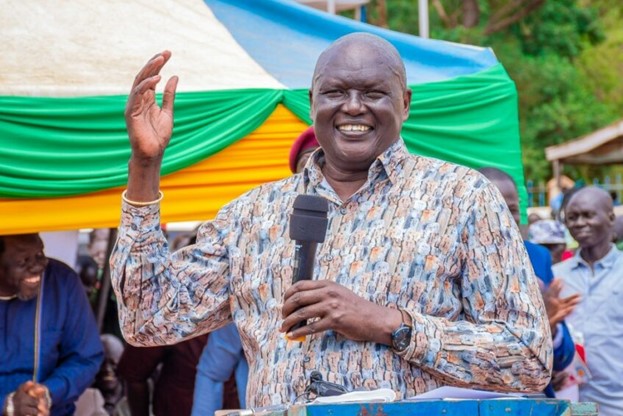
For a man so momentous and with large footprints, ex-Lakes State’s Governor Rin Tueny’s dismissal has left people preempting his next assignment after exiting the state after a five-year stint
By Emmanuel Mandella
In a surprise move late last night, President Salva Kiir Mayardit issued a presidential decree relieving Lieutenant General Rin Tueny Mabor Deng of his duties as Governor of Lakes State, ending nearly five years of leadership in one of South Sudan’s most strategically important and hitherto turbulent states. The decision was confirmed in a broader government reshuffle that saw several senior officials dismissed and reassigned.
Rin Tueny, a senior military officer and seasoned politician, had led Lakes State since June 8, 2021, when he was appointed by President Kiir to restore stability, security, and order in a region long plagued by inter-communal violence, revenge killings, cattle raids, and systemic insecurity.
For a man so momentous, his removal has had tongues wagging, as many argue that his tenure left a legacy that merits continued service at the national level possibly in the national government, as a senior SPLM leader, or a senior rank within the South Sudan People’s Defense Forces (SSPDF).
When Gen. Rin assumed office, Lakes State was widely regarded as one of the most volatile states in South Sudan. Years of communal conflict and lawlessness had displaced families, disrupted trade and agriculture, and eroded public confidence in governance.
Under his leadership, however, the security landscape changed, with multiple civic and civil society organizations crediting him for reducing inter-communal violence, disarming peace disruptors, and restoring normalcy that allowed everyday life to resume in the state’s towns and rural areas.
Governor of the Year- 2022
In recognition of his efforts, Rin was named “State Governor of the Year 2022” by the Community Empowerment for Progress Organization (CEPO) for his role in curbing deadly violence and overseeing the enactment of a state law prohibiting child and forced marriage, a progressive measure that was applauded at national level.
“Lakes State is now peaceful. People are moving freely, children are back to school, local businesses and agricultural productivity have improved,” Rin said upon receiving peace and governance awards, highlighting economic and social gains under his watch in 2022.
A few weeks later, in January 2023, the Governor,alongside his Eastern Equatoria counterpart, Hon.Lobong Lojore, were awarded by LEADS Africa and South Sudan General Students Union for their contributions to institutional development, peace, security and education.
Signaling the recognition, Hon. Rin also presided over major reconciliation efforts, including historic community conferences such as the Agaar Community Conference, which helped reintegrate historically isolated clans and reinforced a shared sense of identity in the state.
Across Lakes State and major cities nationwide, citizens have reacted strongly to the news of Rin’s dismissal, as many residents believe his contributions deserve recognition beyond gubernatorial office, with several grassroots groups advocating for his appointment to a national leadership role, such as Vice President, star-studded military role or a senior leadership portfolio within the SPLM or government.
One resident of Rumbek told The City Review that Rin’s leadership had “brought peace where conflict once reigned,” and argued that “his experience in security and governance is exactly what the national government needs as South Sudan prepares for the December 2026 general elections.”
Civil society leaders also urged the national leadership to consider his tenure as more than just a state governorship but as foundational service that contributed significantly to national stability.
“He has proven that where there is political will, peace can prevail even in the most difficult environments,” one activist said.
Additionally, a political analysts said Rin’s tenure blended military discipline and political acumen, positioning him uniquely among South Sudan’s celebrated leaders.
“His appointment was not just about restoring order in Lakes State, it was also about demonstrating that governance approaches combining security, community engagement, and legislative innovation can succeed even where traditional methods have failed,” said one senior analyst.
A significant drop in inter-communal violence and ambushes following decisive action against armed youth and bandits, and the enactment of laws banning harmful cultural practices such as child marriage and promoting free basic education.
Furthermore his high-impact reconciliation forums and cultural reintegration initiatives that helped heal long-standing divisions across the state.
Experts also note that while his methods attracted both praise and criticism, they helped lay the groundwork for security improvements that have allowed social and economic activities to rebound.
Considering his track record, many analysts contend that appointing Rin to a national security or governance role particularly one focused on national peace building or defense coordination could capitalize on his strengths and set a precedent for rewarding effective state leaders with broader responsibilities.
However, Rin’s approach was not without criticisms. Some human rights advocates raised concerns over reports of heavy-handed tactics, including allegations of political detentions and high-handedness, a classic case being the closing of Lakes State opposition party (SPLM-IO) office in March 2025 following arrest of party officials by the National Security Service (NSS).
These critiques reflect broader debates in South Sudan about how to instill security while upholding the rule of law and protecting human rights.
Despite these concerns, observers have acknowledged that his firm stance helped break cycles of violence that had previously resisted intervention.
As South Sudan’s political landscape continues to evolve with national elections scheduled for December 2026, both proponents and critics will steer there eyes in anticipation of the Governor’s next assignment.
For now, Rin’s legacy in Lakes State of transforming a volatile region into one of the most peaceful and economically promising, stands as a significant chapter in South Sudan’s ongoing search for stability and effective governance.