

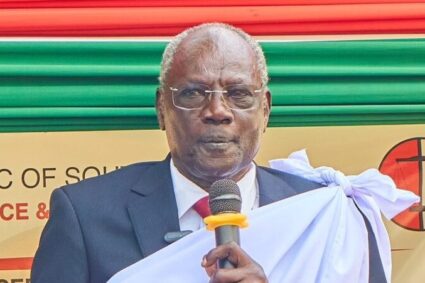


The Minister of Justice and Constitutional Affairs, Rubben Madol Arol, has finally delivered the long-awaited bill for the permanent constitution-making process of 2022 to the Transitional National Assembly for consideration.
The bill was presented for further consideration before it could be enacted and signed into law by the President. This is as required by the revitalised peace accord.
Once in force, the legislation will provide a legal framework to govern the process of making a permanent constitution as well as define the form, powers, and functions of the mechanism factored in the process.
According to the minister, the bill comprises four chapters that were drafted in compliance with Article 6.9 of the Revitalised Agreement on the Resolution of the Conflict in South Sudan (R-ARCSS).
Its provisions will apply to the process of drafting a permanent constitution. It also enables the Revitalised Transitional Government of National Unity (R-TGoNU) to initiate legislation to oversee the permanent constitution.
The preliminary provisions of the bill are found in Chapter One. They deal with the law’s title and commencement, purpose, repeal and saving authority, and application.
The chapter also includes definitions and interpretations of terms used in the bill and the guiding principles of the permanent constitution-making process.
Such are the reconstituted national Constitutional Review Commission (R-NCRC), Constitutional Drafting Committee (CDC), preparatory subcommittee (PSC), and National Constitutional Conference, which are among the procedures of the permanent constitution-making process described in Chapter 2. (NCC).
The chapter requests the national constitutional review commission to be reconstituted, as well as its composition, membership nominations and appointments, tenure and loss of membership, powers and functions, and secretariat.
Details of the law
The chapter also establishes a constitutional drafting committee, as well as its composition, eligibility for recruitment, mechanism for recruiting members, as well as the committee’s powers and functions.
It also covers the composition, nominations, powers and functions, and dissolution of the sub-committee, as well as the selection of members of the preparatory committee to convene the conference.
The chapter also covers the national constitutional conference, its composition, powers and functions, quorum, decisions, and secretariat, as well as the guiding principles that would govern all mechanisms.
The stages of the constitution-making process are outlined in Chapter 3: stage one, two, and three, as well as an annex that is an integral element of the bill.
The fourth chapter deals with funding the process of drafting a permanent constitution. The Audit Chamber will examine the mechanisms’ financing sources, all accounts, and other financial documents.
The bill was presented to parliament after it was approved by the Council of Ministers in its regular meeting number 14/2021 in October, 2021, as per resolution number 65/2021.
As a result, the speaker of TNLA, Jemma Nunu Kumba, referred it to the committee on legislation and legal affairs for scrutiny within 21 days in order for MPs to adopt it into law.