

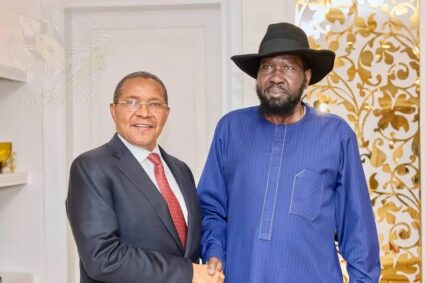


As the curtain draws closer to falling in 2021, President Salva Kiir Mayardit will remember it as a year that he was on his heels pursuing bilateral relations with the neighbours.
President Kiir’s business was not only about bringing sanity beyond South Sudan’s borders but also lobbying for ties to strategically place the country on par with its East African partners.
Kiir extended the saving hands to ensure peace in the region, with Sudan’s case being a success story that culminated in the reinstatement of Sudanese Prime Minister Abdalla Hamdok.
Nevertheless, efforts to improve ties among Sudan, Egypt, and Ethiopia have not yielded much as diplomatic tiffs keep playing out and tensions surge.
Issues at hand
There have been conflicts between Sudan and Ethiopia over borders, while Ethiopia and Egypt have never agreed over the Grand Ethiopia Renaissance Dam’s (GERD) filling.
Despite having good ties with three countries, South Sudan has not been able to address the conflicts between Sudan and Ethiopia, Ethiopia and Egypt, as well as the domestic conflict in Ethiopia.
During the closing of the 5th governors’ forum in Juba, President Kiir expressed concerns over the growing conflict in the region. He urged the regional leaders to close ranks and de-escalate tension between Sudan and Ethiopia.
Egypt is not left out in the contentious GERD project, and South Sudan’s relations with these conflicting nations are yet to provide a remedy.
Mediation
In February, the federal government of Ethiopia welcomed South Sudan’s decision to mediate the stalemate between Sudan and South Sudan over border control.
The spokesperson in the ministry of foreign affairs and international cooperation in the Federal Republic of Ethiopia, Dina Mufti, appreciated the peace lovers, adding that they sought a diplomatic solution.
‘‘Ethiopia appreciates the initiatives of all concerned countries and bodies that offered to assist in resolving the border issue,’’ said Mufti.
‘‘Ethiopia is always ready to negotiate and solve the issue peacefully.” The two countries’ border agreement was signed between Ethiopia and the British Colonial Administration.’’
According to Mufti, the boundary between Sudan and Ethiopia was demarcated by the British without consulting Ethiopia. He said that in 1972, the two countries agreed to demarcate the boundary through the status quo. The Ethiopian government accuses Sudan of defaulting on the status quo.
“… there is no reason for Sudan to violate the status quo at this time.” This belligerence on the Sudanese side does not reflect the longstanding relations between the two countries, and Ethiopia is asking Sudan to respect the status quo.’’
‘‘And Ethiopia believes that our Sudanese brothers and sisters will heed our requests and allow the issue to be settled peacefully.’’
The conflict between the two countries was caused by the claim on the Al-Fashaga area located east of Gedaref state in Sudan, an agriculturally rich strip.
Khartoum accused Addis Ababa in January of killing its civilians after Sudanese soldiers allegedly fired back and raided their farmers and cattle.
Despite being neutral, South Sudan was recently shocked after it was accused of supporting the Tigray People’s Liberation Front (TPLF) against the Ethiopian government.
The Government Spokesperson, Michael Makuei, came out guns blazing to deny the allegations, saying South Sudan could not stab Ethiopia in the back.
“The people and the government of Ethiopia all these years have been standing with us, and without the Ethiopians and the government, we would have not been independent today.”
“There is no way whereby we can say we are supporting the rebels to overthrow the system in Ethiopia,” Makuei said.
Makuei added that the allegations were “baseless and unfounded,” saying the authors of such allegations should be brought to book.
At the inauguration of the Ethiopian Prime Minister, Abiy Ahmed, President Kiir pledged immense support towards the unity and stability of Ethiopia.
“I came here in August for a one-day visit, and I said that we want Ethiopia, which is our great mother. Being a South Sudanese without Ethiopia would have not been what we are today.
“We don’t want our great mother, Ethiopia, to have the same challenge we had in South Sudan.’’
In August, Kiir decided to mediate the conflict between the Ethiopian government and the Tigray forces, following which he revisited Ethiopia on August 26 following a request from the Sudanese Prime Minister and the Chairperson of IGAD, Abdalla Hamdok.
Kiir was viewed as the right mediator, but it was unfortunate that his efforts did not bear fruit. The Ethiopian Prime Minister was reported by international media to have joined the battlefield, a decision viewed by critics as not fit for the Nobel Peace Prize winner, Dr Abiy Ahmed.
Agreements with Egypt
In October, President Kiir travelled to Cairo to strengthen bilateral relations with Egypt. The Egyptian President, Abdel Fattah Al Sisi, pledged his government’s support in terms of political stability, economic resurrection, and security stabilisation.
This was after the two counterparts held a meeting and discussed the future of the previous agreements signed three years ago.
The statement from the office of the president’s on the visit would create a new page of opportunities so that the two nations could revisit their historic cooperation.
“President Salva Kiir’s visit is both symbolic and, at the same time, presents an opportunity for the two countries to explore new areas of cooperation,’’ read the statement.
There was a need to also discuss the Memorandum of Understanding, which had been signed by the two countries.
The MoU included the provision of agricultural land to Egyptian investors and the establishment of educational training centres in South Sudan, among others.
This MoU was inked alongside other agreements in a ceremony that was witnessed by Vice President for Economic Cluster Dr James Wani Igga and Egyptian Prime Minister Mostafa Madbouli on July 27, 2021, to bolster cooperation between the two sister countries.
The memorandum entailed ways of reducing the risk of flooding in the Sudd Swamp in South Sudan. This was reached by the Egyptian Irrigation Minister, Mohamed Abdel Aati, and his counterpart from South Sudan, Manawa Peter Gatkuoth.
The minutes of the meeting were signed by Madbouli and Igga, including the cooperation project and timetable for its implementation. Al-Sisi pledged to support and transfer Egyptian expertise to the South Sudanese in the fields of agriculture and industry.
Regional issues
To curb the volatile border tensions between Ethiopia and Sudan and the GERD project conflict, Kiir asked Al-Sisi to pledge his support towards viable peace in the region.
Al-Sisi assured South Sudan of his support for the peace process in the country and the region as a whole.
“We also exchanged views on a multitude of current regional and international issues of mutual interest; primarily the ongoing developments in the East African region and the Horn of Africa, and ways to contain their possible repercussions for the rest of the region,’’ the statement noted.
“We agree to continue joint coordination to achieve the security and stability of the region’s countries,” he added.
Media reports disclosed that Al-Sisi did mention that they discussed the River Nile issues and the problems related to the Grand Ethiopian Renaissance Dam (GERD) that is being constructed on the Blue Nile.
“I underscored the importance of reaching a legally binding agreement that regulates the filling and operation of the dam, based on the rules of international law and UN Security Council resolutions on the issue.
Sisi underscored, “This shall promote stability in the entire region and open up broader prospects for cooperation among Nile Basin countries.”
GERD is the source of conflict between Egypt and Ethiopia, as Egyptians claim that the dam blocks their waters.
Ethiopia had been strategic in hosting South Sudanese in the course of the liberation struggle together with Kenya and Uganda.
According to researchers, the Grand Renaissance Dam will be the largest hydroelectric power plant in Africa. Its construction began on the Blue Nile in the northern Ethiopian highlands in 2011, where 85 per cent of the Nile’s waters flow.
South Sudan recognises Egypt as the first African country to award scholarships to South Sudan since 1956, which sees the South Sudanese labour force in various disciplines including law, medicine, and engineering, to mention but a few.
In December 2019, South Sudanese students at the University of Juba organized protests against the abduction, torture, bullying, and killing of South Sudanese students in Egypt.
Reports show that students stormed the Egyptian Embassy in Juba against what they called “unfair treatment of South Sudanese by Egyptians.” They said that South Sudanese were abducted intentionally in Cairo for organ harvesting as relatives and friends of victims revealed to the media that the people who were found dead were without kidneys and livers.