

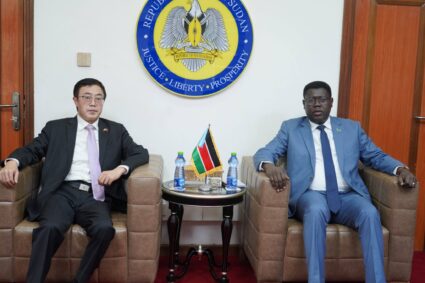



South Sudan has launched the exportation of its first consignment of 22 metric tons of Gum Acacia Senegal commonly known as Gum Arabic to the international market for the first time to diversify the economy.
The commodity, expected to arrive market this month in Europe, marked the beginning of the young African Country’s shift from total dependence on oil as the only source of the revenue.
B-Yor Trading Company in partnership with the Ministry of Trade and Industry will spearhead the shipment and selling of country’s first agricultural product in both national, regional and international markets.
“I want to assure you that the economic cluster will leave no stone unturned to improve the economy of South Sudan. If we double our efforts in producing Gum Arabic, we will forget about the oil,” Dr. James Wani Igga, Vice President and Chair of Economic Cluster said during the launch of the first export Thursday.
South Sudan whose 99 percent income comes from the oil has been greatly devastated as a result of global fall in the oil price since the onset of the COVID-19 in March this year, rendering government incapable of financing the country’s key developmental projects.
South Sudan Gum Arabic was legally recognized under the legal treaty of international trade in March 30, 2020, making it one of the international products in the world market.
The country depends on gross import for all its demands leading to misbalancing trade ledger and Gum Arabic exportation could mark the start of its correction.
Kuol Athian, Minister of Trade and Industry said other challenges were lack of road infrastructure and massive destruction of forests by the community to earn living, adding that it could lower production if no remedy is found.
“We know very well our country has no public roads connecting the producing areas to markets in the country.
“We have billions of Gum Arabic trees that have been destroyed in Norther Bahr el Ghazal and Eastern Equatoria. The forests need protection,” Athian said.
As seen from the picture, Gum Arabic is a dried exudate obtained from the stems and branches of Acacia Senegal.
It consists mainly of high-molecular weight polysaccharides and their calcium, magnesium, and potassium salts, which on hydrolysis yield arabinose, galactose, rhamnose, and glucuronic acid.
The United Nations Conference on Trade and Development report published two years ago indicates that the global market was running short on Gum Arabic, a development expected to present opportunities for African countries to capitalize on the market.
The UN agency said by the time “The transformation of gum arabic production into more income-generating activities can not only promote economic development through higher incomes, but also to secure rural livelihoods, empower vulnerable groups, including women, and promote synergies with natural resource management and climate change mitigation”.
South Sudan is blessed with number of minerals including gold, uranium, and zinc besides millions of cattle and sheep which are underutilized due to insecurity, ignorance, and lack of technical knowhow.