

SSPDF warns military officers against involvement in politics

By Emmanuel Mandella and Opio Jackson
The South Sudan People’s Defense Forces (SSPDF) have issued a strong warning against military officers engaging in political activities, a move aimed at safeguarding the integrity of the ongoing military unification process under the 2018 revitalized peace agreement.
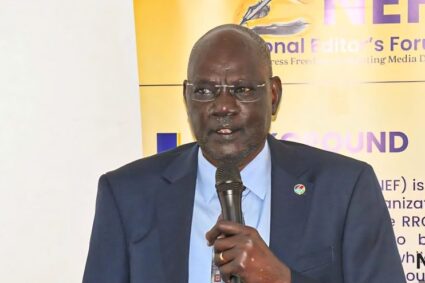
SSPDF spokesperson Maj. Gen. Lul Ruai Koang sounded the alarm following factions of military leaders claiming to be aligned to the South Sudan Patriotic Movement army, commenting on a party’s political developments. The warning comes at a pivotal time as the second phase of military unification prepares to roll out.
“This behavior threatens the cohesion of our forces and undermines the entire peace process,” Maj. Gen. Lul emphasized during a press briefing in Juba. “Military officers must remain neutral to ensure the credibility of our transitional government and the success of this unification effort.”
The SSOA, a key stakeholder in the transitional government, has faced internal disputes, from parties such the South Sudan Patriotic Movement (SSPM) and the Federal Democratic Party (FDP) under Gabriel Changson Chang embroiled facing leadership challenges. Reports of some officers exploiting their positions for political ends have further deepened divisions within the coalition.
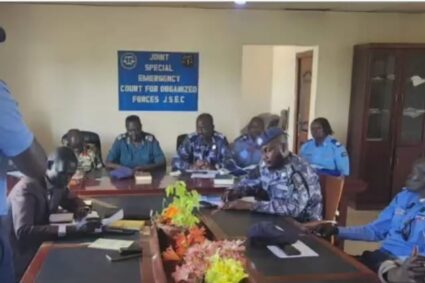
Lieutenant General Garang Akol Ayii, co-chair of the Joint Defense Board, highlighted the risks posed by such actions during a recent meeting.
“Officers engaging in politics or misusing social media for partisan interests undermine the professionalism and unity required for our military transformation,” Lt. Gen. Garang stated.
The SSPDF leadership has made it clear that breaches of the military code of conduct will not be tolerated. Officers involved in political activities or inflammatory social media use could face severe repercussions.
“This is a non-negotiable matter,” Maj. Gen. Lul asserted. “We are prepared to take disciplinary action against anyone who defies these orders.”
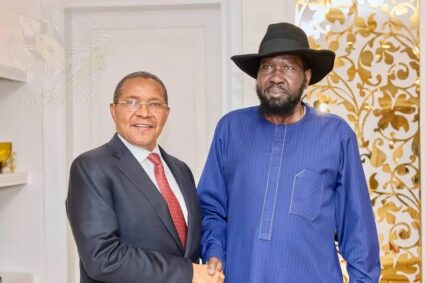
The directive aligns with a 2022 presidential decree by President Salva Kiir Mayardit, which prohibits military personnel from participating in politics or disseminating hate speech online.
Security analysts have lauded the SSPDF’s stance, warning that failure to address political interference could destabilize South Sudan’s fragile peace efforts.
“Neutrality within the military is not just a principle; it is a cornerstone for building public trust and advancing the peace agreement,” said Samuel Duku, a security expert based in Juba.
As South Sudan navigates a delicate path toward a unified military, the SSPDF has urged its officers to recommit to their professional responsibilities.
“This is a time for discipline and unity,” Maj. Gen. Lul concluded. “The success of our peace process and the future of South Sudan depends on it.”
The unification of military forces is seen as welcome process for the country’s transition from conflict to stability. With the SSPDF doubling up on its stance, the spotlight now turns to how effectively these directives will be implemented in the coming months.