

Terekeka land dispute turns deadly as eight killed, schools shut

Leaders have urged for calm as the clashes, which took place in the contested agricultural area of Maduria, escalated into a fierce gunfight involving both heavy and light weapons
By Emmanuel Mandella
Leaders are now calling for calm following a land dispute between the Jor and Koggi residents in Terekeka County over the weekend that turned deadly, leaving at least eight people dead, 18 wounded, and dozens of families displaced.
The clashes, which took place in the contested agricultural area of Maduria, escalated into a fierce gunfight involving both heavy and light weapons. Homes in Koggi Boma were set ablaze, and panic gripped the community as women and children fled into the bush or sought refuge in Terekeka town.
The Koggi side was overwhelmed. Five of their people were killed on the first day. From Jor, eight were wounded and one person died, a witness said.
The violence has led to the closure of Terekeka Secondary and Primary schools, which are now sheltering displaced families. The scale of destruction has shocked local leaders and triggered swift intervention from state authorities, even as Central Equatoria State Governor said it is politically instigated.
Politically motivated
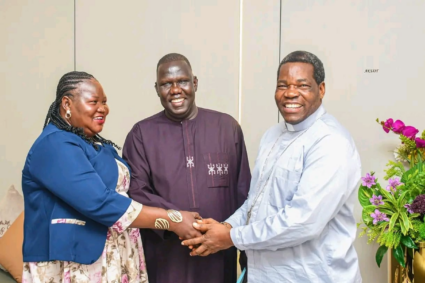
On Saturday, April 12, Governor Jadalla visited the area, condemning the violence and calling for unity among the Mundari people.
“This problem is not caused by you it is stirred by political actors with selfish agendas,” Jadalla told displaced residents. “You are all Mundari people. Unity, not division, must define our way forward.”
The governor ordered the deployment of additional security forces and pledged government support in the form of food, medicine, and temporary shelters.
Acting Information Minister Jacob Aligo, who accompanied the governor, confirmed that nearly the entire Koggi community had been displaced. “We saw damage even in parts of Terekeka town. But the governor’s presence has helped reduce tensions.”
On his part, the Paramount Chief Abraham Gai of Terekeka County commended the Governor’s leadership and expressed confidence in the government’s ability to resolve the crisis. “We are thankful for the Governor’s presence. We now look to the government to handle this matter with urgency and care,” Chief Gai affirmed.
Security remains tight as investigations into the source of the weapons and the root causes of the dispute continue. Authorities are preparing a comprehensive report on destroyed property and possible long-term relocation needs for the affected population.
This incident marks one of the deadliest communal clashes in Central Equatoria this year, raising concerns over unresolved land conflicts and the growing militarization of local disputes.
Caution over attacks
Meanwhile, in a separate incident, civil society activist, Edmund Yakani on Sunday issued a statement condemning the incidences of targeted killing in Malakal Town.
Yakani, the Executive Director of Community Empowerment for Progress Organization (CEPO) advised the residents of Malakal to embrace peaceful to co-exist and avoid culture of targeted killing and revenge attacks.
The activist said he was aware of government officials fueling the violence on tribal line and warned that they would document and name them soon.
“We have seen incidences of targeted killing in Malakal Town. We have seen extrajudicial killings taking place in Malakal Town and we are getting information of a further similar deadly violence may occur in Malakal Town and some parts of Upper Nile State as we have been following what has recently happened as a deadly violence in some parts of Upper Nile State. As a civil society activist, I would like to communicate to sons and daughters of Upper Nile State that whether you like it or you don’t like it, you have to peacefully co-exist,” Yakani.
“For you to peacefully co-exist, you need to avoid the culture of targeted killing, culture of revenge attack, culture of extrajudicial killing, human rights abuse and political discrimination in the state. You need to accommodate each other and for you to accommodate each other, you need to embrace dialogue as an instrument of resolving your differences or grievances, not violence. Violence never pays,” he noted.
“On a separate note, I would like to communicate this to individuals who are fueling violence in Upper Nile State on tribal line that all your actions, we will document them and we’ll soon start naming you. We are aware of some of you who are in our military, in South Sudan people, defense forces and other law enforcement agencies that you are behind fueling this violence going on in Upper Nile. We know some of you are politicians,” he warned.
“We know some of you are religious leaders, individuals working in the non-governmental organization and other non-governmental agencies. And some of you are traders in the market. We know some of you are chiefs. We know some of you are in diaspora. We are collecting evidence that will empower us to name you as one of the people who are perpetuating this deadly violence in Upper Nile State,” Yakani emphasized.
On Friday April 11, 2025, Radio Tamazuj media outlet reported that several residents of Malakal, capital of Upper Nile State suffered from targeted attacks.
Upper Nile State Police Commissioner Gen. Mayen Akon told Radio Tamazuj that only one incident had been recorded by the police—an individual attacked and injured in the market. “We heard the victim was holding money, but I can confirm it was not a fight. He was taken to hospital after filing a police report,” he said.