


Timely payment of salaries can boost the economy, says expert

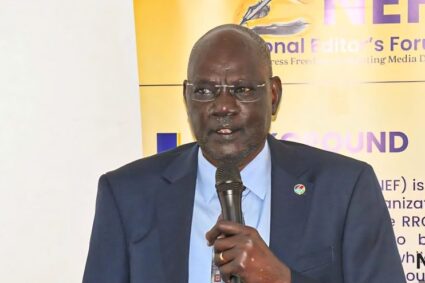
Abraham Maliet, a leading economist, said regular payment of civil servants’ salaries could boost money circulation and generate income.
By James Chatim
A South Sudanese economist has said regular payment of salary, if properly implemented, would boost the economy of the country.
Abraham Maliet, a leading economist, said regular payment of civil servants’ salaries could boost money circulation and generate income.
In his interview with The City Review on Monday, Maliet welcomed the statement by the Vice President of the Economic Cluster Dr. Benjamin Bol Mel on the timely payment of civil servants’ salaries.
According to him, the money will be in circulation and thus boost people’s purchasing power.
“The circulation of money in the market can generate income for the government, which may lead to economic development as an input,” he said.
“What the new VP of the economic cluster said, in my capacity as somebody with technical know-how, (the significance of) money is when it is circulating. So, the statement of the VP that they will pay the salary and arrears means that the money will be with the people, it will be on the people’s hands, and then it will circulate. When it circulates, it will generate income by itself,” Maliet explained.
The economist said there will be money in the market and as a result, the market will be busy.
“So, it is a part and parcel of economic development because there is an input. It’s normally about input and output,” he added.
“So, input is the resources including money. Money is also a resource. If you put it in there, it will give you some output. So output, there will be stability. There will be money to purchase. There will be a purchase. A purchase means the government will benefit as well as the citizen or somebody who has money will benefit.”
He further said that once there is no cash in the hands of people that means the economy is sleeping.
“Now you see there is no cash, then the economy is sleeping,” Maliet explained.
However, he said the country has enough resources to introduce measures such as the digital platform for payments to address the issue of cash in hand.
“The country itself is full of resources. And the thing is that our resources have not been utilized. Now with the new people, there will be new energies and new ideas. There is a high way of making money, which means some of the resources that we have will have to be commoditized.”
“I remember a few weeks ago, the Bank of South Sudan introduced what they call a digital platform for payments. The good thing about the digital platform for payment is it addresses the issue of cash in hand. If we are doing electronic payment, then the cash that runs around with people will be limited,” Maliet said.
He said with the new payment system one needs no cash to pay their bills. For instance, if the wants to pay its employees, it will not have to pay them in cash.
“Instead of giving them cash, the government can pay them digitally. If the government owes you SSP 200 million, instead of giving you SSP 200 million in cash, it can do transactions by platform payment. And that now will address the issues,” he stated.
He said that for the last four months there have been issues of limited cash in the market because many are now using e-money.
“There is no cash in the market not that there is no money. There is money, but we call it e-money. So we are doing something called e-business. We will pay as we go.”
He said there is no need for one to carry bags of cash while using a digital platform payment.
“So that will solve one single issue, which is the cash problem,” Maliet said.