




By Ajah Jennifer
At the ongoing Juba Economic Forum, hosted by the Bank of South Sudan, several compelling insights into the country’s livestock sector came to light. According to official statistics, South Sudan possesses more livestock than its human population. While livestock plays a significant role in the socio-economic fabric of South Sudanese society, the sector remains largely informal and underdeveloped, with commercialization being notably minimal. This is largely due to the country’s reliance on traditional, subsistence-based livestock production systems.
As part of national efforts to strengthen the economy, the Ministry of Livestock and Fisheries has called for the commercialization of South Sudan’s vast livestock resources, emphasizing their untapped potential to drive economic transformation.
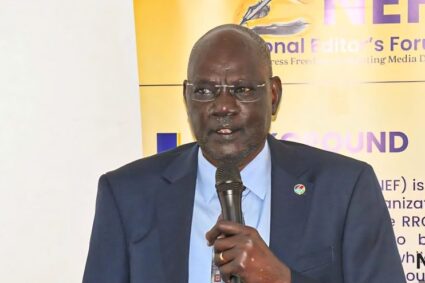
John Kang Gang, Director General of Marketing and Investment at the Ministry, described the livestock sector as a “gold mine,” referring to the abundance of cattle and fisheries available.
Despite this wealth, South Sudan continues to import much of its meat from neighboring countries. Traditionally, livestock has been valued primarily as a symbol of prestige and a resource for marriage, rather than as a commercial commodity.
Speaking at the forum on Wednesday, Kang stated, “If we export to other countries, a single cow could fetch between USD 2,000 and 3,000. Therefore, we must encourage our livestock herders to engage in export for income generation.”
Underscoring the sector’s economic potential, Kang emphasized that shifting from subsistence to market-oriented production requires improved feeding, healthcare, and breeding practices. He also highlighted the importance of market access, infrastructure development, and enabling policy frameworks to attract private sector investment.
South Sudan’s livestock already supplies over 70% of the country’s meat needs, forming a strong base for commercial growth. Furthermore, the livestock is largely organic, aligning with global trends favoring naturally raised meat products.
However, several challenges continue to hinder the sector’s progress. These include insecurity and cattle raiding, poor infrastructure, and cultural resistance to commercialization.
“Our livestock production system is mostly subsistent—direct from the farm to the consumer. But if we transform this system and decarbonize it, we can generate much more income,” Kang explained.
He also called for training programs to equip pastoralists and livestock keepers with modern animal husbandry techniques to help shift the sector from a survival-based model to a sustainable, market-driven one.
“When we move from survival to sustainability, livestock becomes more than just food—it becomes a financial asset,” he concluded.