


WHO confirms Cholera outbreak in Juba County, as MSF warns of escalation

As of December 3, South Sudan had recorded a total of 1,526 suspected and confirmed cholera cases, 880 of them being treated at the MSF facilities, with Juba recording 169 cases so far
By The City Review Editorial
At least, six states and 18 counties including Juba County have been affected by Cholera, according to the World Health Organization.
Dr. Eric Rurangwa, the Incident Manager at the World Health Organization, said the public is still unaware of the prevalence of Cholera in Juba and called on the media to educate the public.
“Now we have 6 states affected, more than 18 counties, including Juba,” he said.
“The people affected are increasing because of poor hygiene, how we take the sanitation, the wash issues especially for health-seeking behaviour,” Rurangwa said.
He challenged the Journalists to do more to create awareness among the communities on the prevalence of Cholera.
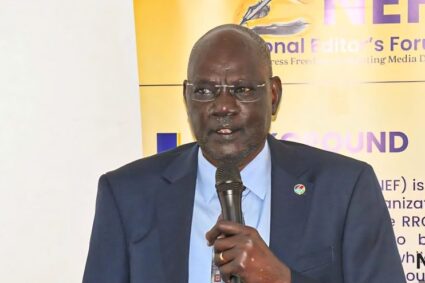
The Director of Health Security Emergency Workforce Development in the national Ministry of Health, Dr. Angelo Goup Thon also called upon the Journalists to be more alert on emergency cases like a disease outbreak and whatever emergency poses hazards to the population.
He urged the media fraternity to be the first people to communicate to the public when there is an emergency,” he said.
“Always talk to authorized people, so that you get more reliable, accurate information.”
On Friday, Hon. Najwa Juma Mursal, Central Equatoria State Minister of Health briefed the State’s Governor, Augustino Jadalla, on the latest situation of the outbreak of cholera across the State.
Speaking to the media following her meeting with the Governor, Hon. Najwa revealed that the State Health Ministry has recorded 169 cases of cholera so far, with 9 deaths in Juba County and City Council. The state minister said that through the help of health partners, the Ministry established an Incident Management Committee for Central Equatoria State for managing the outbreak through enhancing awareness, case management and community engagement.
“I want to give my message to the people in the State that they have to be vigilant and follow health measures mainly to our people in Protection of Civilians Site (POCs), Hai Baraka, Mangateen and Jebel Yesua. Because this disease (Cholera) needs the coordination and support of the community especially in mobilization and information,” Hon. Najwa said, urging the people to report any suspected cases of cholera to any nearest health facility.
The state minister called on the public to take preventive measures such as practicing good hygiene, drinking clean water, washing of hands with soap and water before and after eating, thorough cooking of food among others.
The National Ministry of Health declared a cholera outbreak in October, 2024. Signs and symptoms of cholera include watery diarrhea, fever and vomiting.
As the cases surge in Juba, the threat of cholera has continued to be reported in other regions, with Upper Nile recording significantly high cases.
Worrying cases in Upper Nile
In its statement released to the media, and extended to The City Review, Médecins Sans Frontières (MSF), expressed concerns about the rapidly escalating cholera outbreak in Malakal, the capital of Upper Nile State.
Since the first suspected case was reported on 5 November, MSF reported, the number of people affected has risen significantly, placing an immense strain on the limited response to date.
According to the medical charity, by December 3, a total of 737 cholera cases were reported in Malakal, with the organization treating 646 patients – more than 87% of all cases.
“The situation in Malakal remains critical, and we are concerned that the outbreak is spreading to neighbouring areas such as Tonga and Kodok. MSF urgently set up the 100-bed cholera treatment centre (CTC) in Assosa and continues to provide critical medical care; however, significant gaps remain, especially in the number of functioning oral rehydration points (ORPs) and water and sanitation,” Zakaria Mwatia, MSF head of mission in South Sudan, noted in a statement, adding:
“We have been stretched thin in our response as we have had to expand our efforts to address critical gaps in the ongoing response.”
The outbreak, initially declared in Renk, Upper Nile State, on October 28, 2024, has spread to Malakal, Bentiu in Unity State, Aweil in Northern Bahr-el Ghazal state, and even South Sudan’s capital, Juba, MSF said, attributing the surging numbers and the first case to Renk, being the major entry point for refugees and returnees from Sudan, as well as the inadequate living and hygiene conditions to the disease’s rapid spread.
“Over 850,000 people have crossed from Sudan into South Sudan over the past 18 months, around 75% of them through the Renk crossing into Upper Nile State. The ongoing influx of refugees and returnees into South Sudan continues to pose risks to the already fragile situation and puts additional pressure on an already much overstretched health system,” MSF highlighted.
“This highlights the urgent need for a stronger response to not only curb the spread of cholera, but also strengthen the delivery of critical health services across the country.”
Escalating national figures
As of December 3, South Sudan had recorded a total of 1,526 suspected and confirmed cholera cases, 880 of them being treated at the MSF facilities, the aid organization reported.
“More than 70 per cent of the reported cases are in the Upper Nile State alone,” the organization said, expressing concerns over the slow preparedness in other surrounding areas.
MSF has disperched its team to respond to the disease, with its staff educating the community about cholera prevention and transmission and undertaking contact tracing to identify potential cases and refer them to the medical facility.
“We urgently call for immediate and substantial scale-up of activities to contain this outbreak and prevent further suffering. This requires a collaborative effort from all involved,” Zakaria stated.
The aid group called on stakeholders, including the South Sudanese government, UN agencies, and other humanitarian organisations, to immediately increase their efforts and resources to respond to the cholera outbreak.
Cholera is an acute form of diarrhoea that is treatable with antibiotics and hydration, but can kill within hours if left untreated. The disease is caused by a germ that is typically transmitted through a lack of access to sanitation. People become infected when they swallow food or water carrying the bug.
The rapid spread of the disease comes at a time when the country is experiencing devastating flooding from the torrential rains that have for several months caused anguish to the South Sudan public, submerging homes, destroying crops, sweeping animals and causing deaths.
“We urgently call for immediate and substantial scale-up of activities to contain this outbreak and prevent further suffering. This requires a collaborative effort from all involved,” Zakaria Mwatia, MSF head of mission in South Sudan.