



President Salva Kiir Mayardit has barred the parliamentary recess in a bid to allow for the discussion of bills that need urgent attention, among them the national budget for the operation of the Revitalised Transitional Government of National Unity (RTGoNU).
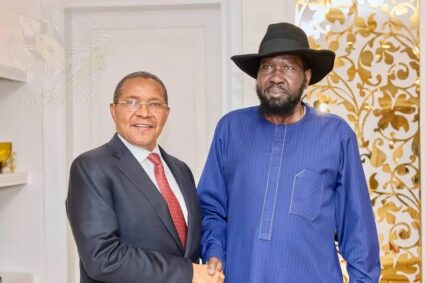
The decision stemmed from the president’s meeting with the Speaker of the Reconstituted Transitional National Legislative Assembly (TNLA), Jemma Nunu Kumba, on Wednesday.
According to the statement of the speaker aired on SSBC, the president called off the recess because the parliament had a backlog of duties.
“We made consultation on the issue of recess for the national assembly, as per our regulations. The speaker is to consult with the president on the issue of recess. On this issue, His Excellency the President has directed that the MPs will not go for recess this time, although the calendar requires that we go for recess at this time,” Nunu said.
“But due to the urgent bills that are available to be enacted by the legislative assembly, the parliament will not go for recess so that we can handle these urgent bills especially the budget which needs to be tabled urgently and other bills which are related to the implementation of the Revitalised Peace Agreement,” she added.
No budget for recess
The bills that need to be urgently passed include the budget bill, the security bill, and the political parties act bill among others that need the input of the specialised committees to be passed.
A member of RTNLA and a representative of SPLM-IO, Jesus Deng Atem, said that the recess would have started on the first week of December 2021, and ended on the first week of March 2022.
But he revealed that this needed a budget to enable the lawmakers to travel to the grassroots to assess people’s needs before presenting them to the House.
“Money is needed for us to go to the grassroots to bring issues of concern from the people and present them in the parliament. But we don’t have cars and there is no budget to use other means to go to flood-affected areas,” Deng explained.
“We first received SSP1,000,000 as a gracing fund and only recently received SSP300,000 as Christmas bonus. We don’t have a medical allowance, sitting allowance or even our salaries since we were appointed. However, the most important thing is that we must implement the peace agreement.”
He added that some of them had no cars to travel to villages to hold meetings with their constituencies.
Suspending recess normal
Zakaria Matur Makuer, who is also a member of parliament in the R-TNLA, said suspending the recess was a normal business in parliament.
He said that the president and the leadership of the parliament agreed that members of parliament should not go for recess because they have not exhausted the bills they should have worked on beforehand.
“Normally, when the parliament is going for recess, they have exhausted some of their work during that term. Since the parliament was reconstituted, there has been no actual work in parliament,” Matur explained.
“So, when we requested for recess, the president of the country said we have a lot of bills for us including security bill, so you cancel your request for recess. It has been accepted by the leadership of parliament because there is a huge work in front of parliament they need to attend to instead of going for recess.”
Albino Akol of Other Political Parties (OPP), said the members of parliament were waiting for the speaker to pass the directive from the president so that they could endorse it as they continue with the extraordinary sessions.
“According to our conduct of business, we have two sessions in each year: one of the sessions will start on the first Monday of April until the second Wednesday of July. And then the second starts on the first Monday of September and ends on the second Wednesday of December,” he said.
“We have a lot of legislation that we did not enact, so we understand that we still need to work so that we do all these. We as the MPs will just receive what the president has said, and we will endorse it.
“We even don’t need any recess because we need to finish on time with the necessary laws that will support the implementation of the peace agreement, we are aware of this,’’ he added.
Legislatures directed
During the first sitting of the Transitional National Legislature on August 30, 2021, at Freedom Hall, Kiir directed the assembly to work on the budget bill among other bills urgently.
“Today, I am drawing your attention to these files to ensure that they top your legislative agenda. One of such files is the National Budget. It has already been debated and approved by the Cabinet, and it awaits your discussion and final approval,” said the president.
“I urge you to take this up as a matter of urgency because the country cannot any longer afford to operate without an approved budget,” said President Kiir.
Delays of bills
The Reconstituted Joint Monitoring and Evaluation Commission (RJMEC) three weeks ago said the delay in enacting of bills was of concern if the revitalised peace agreement is to be fully realised.
“Further, it [RJMEC] urged the reconstituted TNLA to fast-track its handling and enactment of all the bills and welcomed the reported assurance from the TNLA that it will not take a prolonged recess as was the practice in its calendar,” partly read the recommendation.
However, the delays had been blamed on the failure to form the specialised committees which should work on some of the critical bills like the budget and security bills among others.
The chairperson designate of the information committee of the R-TNLA, Paul Yoane Bonju, cited the lack of a chamber for the parliament to conduct business as the reason for the delay in giving the governor’s forum which took a week as one of such hindrances as it was conducted at Freedom Hall.
“Had it not been for the governor’s forum, we should have started with the constitutional amendment bills numbers 8 and 9, which is one of the prerequisites of the agreement,” said Yoane.
“It is a matter of us having the committees and everything will go as normal. We have waited for months and years. What is 21 or 29 days? Although it looks discouraging, let me say, within three weeks, we will have everything in place.”
According to Bonju, the most awaited bills include; the South Sudan People’s Defence Forces (SSPDF) act, the national correctional service act, the wildlife act, the national security service act, and the South Sudan National Police Service Act that have been amended by the Constitution Amendment Committee.