

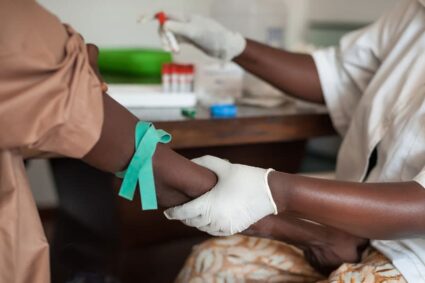


Frontline healthcare workers have raised various concerns accusing the ministry of health and the National high-level taskforce for COVID-19 of negligence and mistreatment.
The medics met on May 27, Thursday, where they issued an ultimatum to the ministry to pay their nine-month dues failure to which they would strike.
“We have laid down our tools and nobody is going to work until our money is paid [and that is when will be] resuming our normal activities [to contain] COVID-19 in the country,” said John Mabior, the head of workers union as he addressed journalists in Juba.
Despite several donations in support of the fight against COVID-19, amounting to millions of US dollars, the medics complained of negligence saying such funds had never benefitted them.
“This is why we are laying down our tools. We only hear about the donations in media, nobody has ever told us about the money and we don’t know where the money is,” Mabior lamented.
The medics said they joined the fight against the virus as the frontline healthcare workers in the spirit of nation building to control the spread of the disease. But their efforts to demand what is rightfully theirs have proved unfruitful.
“We took this long to demand for our money because this is our country. We were thinking that we are saving the nation thinking that our government and the authority will talk to us so we could not go beyond that,” John said
Grievances
Faced with the lurking dangers of contracting diseases on the job, the healthcare workers decried lack of insurance plans and daily and allowances.
“Today, if I happen to die, my family will lose me for all: I will leave for my children and yet I am working for the nation and that is what all of us are facing.”
According to the doctors, they are currently outstretched due to the huge number of patients competing against a very lean number of medics. For instance, they said that there are only 250 healthcare workers to do testing, carrying of dead bodies, screening and serving in Rapid Response team all over the country.
Abraham Ajok, a manager of the data system, revealed that they have decided to stop responding to alerts and other response activities.
“We will not be able to respond to mortalities. For cases that were confirmed last week we will not be able to follow up to know their conditions and then for the media and the rest of the world we will not be able to get data as usual,” he warned.
Ajok encouraged the public to be vigilant to COVID-19 and that they should take care of themselves because they [medics] would not be able to help them when called upon to respond to alerts.
“Up to today [May 27, 202] the team at the airport (port health pulse the EOC team), case management, data, and contact tracing and risk communications have stopped today until the 9 months’ salary dues are cleared. If the government pays us our money and requests us to return to work, then we can automatically do the job without empty promises,” he said
However, the South Sudan Public Health Emergency Operation Center [PHEOC] Doctor Anglo Goup Thon said he did not receive a written document from the frontline healthcare workers concerning the issue of laying down their tools although he was told verbally
“My team has [not been paid for] more than seven months but they are working…they met as a team and they came up with some points to be presented to the ministry of health.
“I am about to receive this information from the team and then I will present it to the ministry and then we will follow up the payments,” he said.
Uncertain promise
He also explained that doctors have not been paid due to some challenges in the ministry of health and the ministry of finance.
“The information we are getting from the ministry [is] that the money is going to come [but] I don’t have the tentative date and that is why my team is not happy,” he added.
The Rapid Response Team Coordinator Dr. James Chan Jock confirmed that the frontline health workers were supposed to receive some incentives from the ministry of health to cushion them from the salary delays.
“And this is why now we are demanding our government through the ministry of health and the National high-level Task force to provide our incentives and the response will go well,” he said.
He said were receiving some incentives from the World Health Organization but they have stopped since March.
The tussle attracted the attention of the Executive Director Foundation for Democracy and Accountability Governance, David Jame Kolok, who said the health workers have ‘every reasonable ground to have taken the steps that they have taken.’
“The only option is to ensure that the government act quickly and to their demands [FHCW], and it is important that they respond quickly because we are actually at a state where when you look at the regional strain of COVID-19, you will notice that there seems to a be a very high spiral especially in countries such as Uganda and also the Indian viral being detected in the country,” he said.
“The ministry of health needs to quickly sit down with the leadership of the frontline health workers and immediately respond by ensuring that they prioritise whatever resources exist in the government to make sure that these people are paid.”