




Firing squad not best solution to fight corruption, says Yakani

According to the activist, fire squad is a traditional way of demanding disaster, which mounted to a death penalty, and is prohibited by international law
By Aguok Chok and Emmanuel Mandella
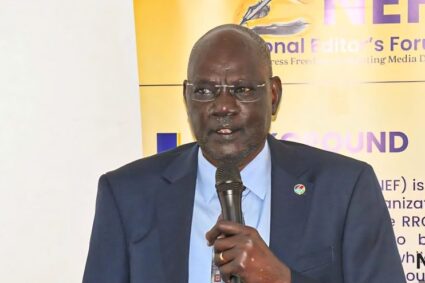
The Executive Director of the Community Empowerment for Progress Organization (CEPO), Edmund Yakani, has strongly rejected the proposal to fight corruption through a firing squad.
Yakani was responding to the statement by the Vice President, Taban Deng Gai, who suggested a “firing squad” as the solution to corruption in the country.
He made the statement on Monday during a trade forum in Juba.
However, Yakani warned that this could seriously undermine human rights and the rule of law.
“Fire squad, it is a traditional way of demanding disaster, which mounted to a death penalty, and which is prohibited by international law,” Yakani stated.
He emphasized that while corruption has serious impacts—comparable to crimes against humanity—it must be tackled through proper legal and judicial means. “It’s good for people who are corrupt to be held accountable in a due legal process,” he continued, warning that anything short of this risks compromising the principles of justice.
The activist called for strengthened legal frameworks and institutions to fight corruption, not extreme punishments.
“We wish that someone like his ex-Vice President Taban should actually promote anti-corruption legal judiciary process,” Yakani said.
He stressed the importance of having anti-corruption courts to ensure the corrupt are properly prosecuted instead of the firing squad.
Yakani highlighted that corruption is not limited to the public sector alone, “Even in the non-governmental sector, there is still corruption.”
However, Yakani lamented the absence of political responsibility, “There is no political will and commitment to fight corruption in the country.”
He said even those with the power to act are often complicit.
According to Yakani, the suggestion made by Vice President Taban clearly shows that the government has felt the impact of the corruption.
He explained that such statements reveal how corruption has grown to a scale where even corrupt officials now suffer from its consequences.
“Why do you fire a squad if you cannot apply the judicial system that is functional?” he asked.
Yakani stressed that addressing corruption requires institutional reform and leadership accountability.
“They need to instill the culture of fighting corruption by making sure that all instruments that promote transparency and accountability are functional,” he stated.
He highlighted the importance of adequately funding institutions like the Anti-Corruption Commission and the National Auditor General.
On the international stage, Yakani warned that South Sudan’s image is suffering. “Previously, we were in the third position. Recently, we came into second position. Right now, we are in the first position,” he said, referring to corruption rankings. He noted that this discourages serious foreign investors, reducing job opportunities in the country.
Yakani sent a clear message to corrupt officials, “They may feel today the application of the law is not in function, but one day, one time, if they are alive, they will find themselves answering questions of corrupt practices in a competent court of law.”
He urged the Anti-Corruption Commission to be more proactive, “The Anti-Corruption Commission needs to be vocal, not silent,” he said, calling on lawmakers to support the fight against corruption.