



Geopolitical tensions, USAID cuts pose threats to emerging economies, BoSS warns

Monetary Policy Committee attributes challenges confronting the financial and banking sectors, noting modest improvements in some important macroeconomic indicators.
By William Madouk
Economic experts at the bank of South Sudan are raising concern about the continued geopolitical tensions in Sudan, Gulf of Aden and USAID cuts, citing that they have profound negative impact on development and emerging economies.
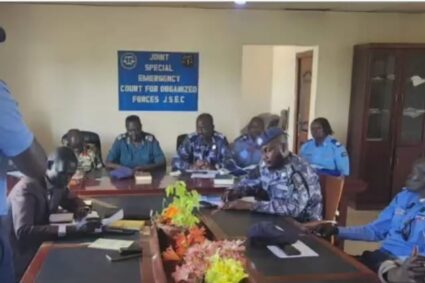
The comments were raised during the Monetary Policy Committee (MPC)’s extraordinary meeting at the Bank’s head office in Jonduru – chaired by Dr. Addis Ababa Othow, the Bank’s Governor and Chairperson of the MPC.
“The meeting raised concern about the continued geopolitical tensions, in particular the conflict in the Gulf of Aden and Sudan,” he said.
The MPC added that the move by the US Administration under President Trump to slash the USAID budget, “will have profound negative impacts on the developing and emerging economies, especially the nascent economy like South Sudan that depends on the USAID budget to support critical social sectors such as education and health.”
“The meeting reviewed recent macroeconomic developments and noted that the global economic environment is characterized by downward trends due to elevated risks and policy uncertainty amidst shrinking finance space,” the Central Bank said in a statement.
As a result, in its April 2025 economic outlook, the International Monetary Fund (IMF) reduced global economic growth to 2.8 percent from 3.3 percent in 2024, and worldwide inflation is likely to vary from its trend.
The committee lauded the ongoing efforts by the government to invest in agriculture and mining sectors to diversify the economy.
“Economic diversification is the only viable way that will help the country to avert and minimize the negative impact of external shocks,” the statement noted.
The Committee attributed the challenges confronting the financial and banking sectors and noted modest improvements in some important macroeconomic indicators.
“For instance, inflation declined from an average of about 60 percent in December 2024 to about 19.8 percent in the first quarter of 2025 due to the tight monetary policy stance adopted by the central bank,” Boss stated.
Central Bank said South Sudan’s economy is dependent on a single export commodity, which is crude oil, and affirmed that the steep drop in international oil prices will harm expectations for healthy economic growth.
“Considering the above, the MPC commended the bank’s management for resolving to adopt appropriate measures aimed at restoring confidence in financial and banking sectors.”
To achieve these goals, the MPC amended key policy instruments and unanimously resolved to cut the central bank rate (CBR) by 200 percentage points, from 15% to 13%, to drive and promote credit to the private sector and maintain vigorous economic growth.
“The MPC also revised the Reserve Requirement Ratios (RRR). The MPC maintained the Reserve Requirement Ratio (RRR) for South Sudan Pound (SSP) at 20 percent of total deposits and raised the RRR for foreign currency (e.g., US dollars, Euro or pound sterling) from 20 percent to 25 percent of total deposits with immediate effect,” statement continued.
“The Bank of South Sudan remains committed to supporting the economy at these tough times, and we are confident that the banking sector will navigate successfully through the fears and uncertainty,”