


President Kiir reaffirms plan to improve Juba International Airport

…as newly appointed Civil Aviation DG, John Woja Elinana, says body is collaborating with key partners to ensure air transport capabilities and standards align with global practices.
By Chuol Chanyong
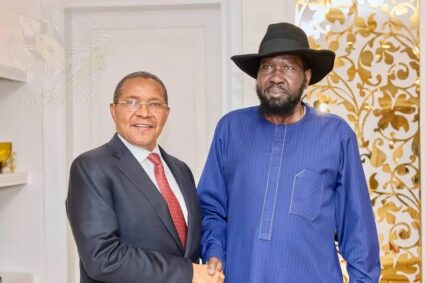
President Salva Kiir reaffirmed his administration’s commitment to the modernization of Juba International Airport, emphasizing its importance for the growth of air transport in boosting South Sudan’s economy.
President Kiir’s remarks followed his receipt of a detailed report on advancements of the country’s civil aviation sector from John Woja Elinana, the newly appointed Director-General of the South Sudan Civil Aviation Authority (SSCAA).
Woja highlighted significant improvements in air safety, airport security, and access control since taking over the office.
He described them as pivotal achievements for the sector, adding that these developments were part of a broader initiative aimed at enhancing governance and operational efficiency within the sector.
He disclosed that the SSCAA was continuing to collaborate with key partners to ensure that South Sudan’s air transport capabilities and standards align with global practices.
According to him, this will boost opportunities for increased air connectivity, attracting investments, and stimulating economic growth.
Earlier, in September, the Revitalized Transitional National Legislature of South Sudan ratified the 2024 amendment to the South Sudan Aviation Authority Bill of 2012, which seeks to reform and unify civil aviation laws.
The amended Civil Aviation Authority Bill authorizes the regulation of safety and security in the aviation sector. It grants the SSCAA independent responsibility to oversee, promote, and ensure the safety and security of airspace.
The purpose of the bill is to provide a regulatory framework for the South Sudan Civil Aviation Authority, establish an independent financial and administrative institution to oversee the civil aviation industry, and develop a system to ensure airspace, airport, and airstrip safety and security, as well as compliance with international aviation standards and best practices.
The President’s assurance comes at a time when the country has reported significant cases of air accidents, raising questions on the state of airlines and regulatory framework in the industry. In August last year alone, two plane crashes happened in a row, the first, which happened on August 8, involving a humanitarian cargo aircraft and led to the death of three crew members and left four others seriously injured.
And on August 9, a UN Humanitarian Air service Plane had an emergency landing at Malakal Airport with 35 passengers on board after losing all its tires upon takeoff from Maban. Even though no one was injured, the eye-popping experience left many concerned over the quick developments, barely three days away from each other.
To avert such incidences, the legislation passed last year by the national parliament recommended reforms in the industry, which includes prohibiting old planes from operating in the country, upgrading airport infrastructure and employing qualified staff.
With the passage of this bill, there some element of hope that the nation’s air travel will be more reliable and secure, paving the way for improved regional and international connections.
As South Sudan looks to modernize its aviation infrastructure, the government is optimistic that the newly empowered Civil Aviation Authority will be able to address long-standing issues, including safety and investment challenges.