

Yakani: We have made notable achievements, but also staggered on key issues

By Aguok Chok
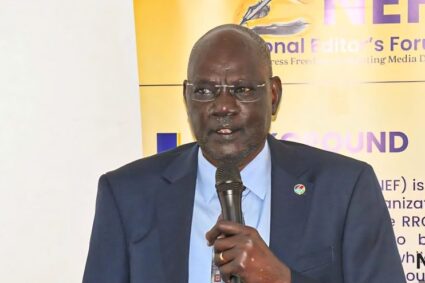
Reflecting on the country’s journey to independence and progress thereafter in an exclusive interview with The City Review, civil rights activist Edmund Yakani said it was one marked by oppression, marginalization and an ultimate clamour for rights and freedoms.
Yakani reckoned July 9, 2011, when South Sudan officially became the world’s newest nation: “I felt independent, and even up to now, there is much more to it.”
“For me, independence means equal treatment of citizens without any form of discrimination, respect for human rights, promotion of democratic governance, and ensuring that South Sudanese feel they are citizens without reflecting or without any focus on their tribes, communities or whatever thing that discriminates them.”
He emphasized that now is the time to “stand up against oppression and marginalization,” both as individuals and institutions.
However, Yakani did not shy away from expressing disappointment. “Unfortunately, as we are commemorating the 14th anniversary of our independence, immediately after our second year of independence, we break out the violence,” he said, noting that his early hopes for a peaceful, democratic nation have not been met. “I can’t score really so much expectation that I met.”
Notable achievements, shortcomings
Still, Yakani acknowledged certain national achievements. “We have a flag, we have a country,” he said, pointing to the private sector’s resilience despite weak public service delivery.
He also applauded the national basketball team, terming their success in Africa and globally “a proud achievement.” Other areas of progress, he said, include boxing, athletics, and the Ministry of General Education’s recent efforts. He also noted infrastructure achievements like roads connecting Juba to Terekeka and Bor.
But he was clear about the biggest failure: “Peace and stability since 2013 until today can’t prevail in our country. Our political leaders have built deficit in trust and confidence that they have made it to be the underlying factor of denying the country to transition from violence to peace.”
Ongoing violence, including incidents in Nasir, Wollang, and Panjume, along with abductions and ambushes, remain a serious concern. “The culture of violence is still a major setback,” Yakani stated.
Civil society is also under pressure. “The civic space is shrinking,” he said. With donor funding cuts, like that from USAID, he warned that civil society “is reducing in numbers or they are sinking.”
Looking ahead, Yakani called for change. “I hope that in the next independence ,we will be talking about post-conflict reconstruction, not talking about violence and peace.” He ended with a strong appeal: “Let us stand up for post-conflict situation.”